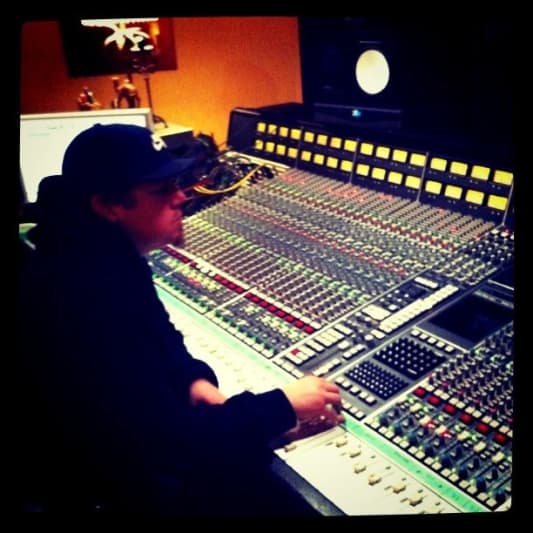
Eric Powell is a producer, mixer, and composer with 30+ years in alternative, electronic, rock, metal and industrial music. As the founder of the lenfendary band 16volt, he's worked alongside collaborators from Nine Inch Nails, Ministry, and Skinny Puppy, charted #1 on Rolling Stone, and synced music to Lionsgate, MGM, HBO, MTV, CBS, ABC, and Sony.
Just after attending Full Sail Center for the Recording arts, with a degree in Recording Music and Production, Eric signed his first record deal in 1991, went on to release ten studio albums, and earned #1 and #2 slots on Rolling Stone's alternative charts — with press in Guitar Player, Kerrang!, Metal Hammer, and Alternative Press to name a few.
His work has involved collaborators including Bill Kennedy (Nine Inch Nails, Megadeath, Motley Crue), David Ogilvie (Nine Inch Nails, Skinny Puppy), Joseph Bishara (The Conjuring, Insidious, Annabelle), Chris Vrenna (Nine Inch Nails), and Jeff "Critter" Newell (Ministry, Blink-182), while his sync catalog spans film, television, and games — from Repo! The Genetic Opera and Carrie 2: The Rage to MTV's Punk'd and The Real World, HBO, CBS, ABC, and Sony Computer Entertainment’s Primal, EA Sports' NHL 2005, and more. As a remixer, he has worked with KMFDM, Skold, Chemlab, Angelspit, and more across labels including Metropolis, Cleopatra, and Artoffact.
Working from his private studio in Portland, Oregon, Powell brings a songwriter's ear, a programmer's precision, and decades of major-label and independent experience to every project — whether producing from the ground up, mixing, composing for picture, or reimagining existing work.
Send me an email through 'Contact' button above and I'll get back to you asap.
Credits
Discogs verified credits for Eric Powell (2)- 16 Volt vs. Hate Dept.
- Unit:187
- The Aggression
- Acumen Nation
- VooDou
- 16Volt*
- Bozo Porno Circus
- Chemlab
- 16Volt*
- Angelspit
- Various
- 16 Volt
- 16 Volt
- 16Volt*
- 16 Volt
- 16 Volt vs. Hate Dept.
- 3D House Of Beef
- Various
- 16 Volt
- Various
- Various
- 16Volt*
- KMFDM
- 16Volt*
- 16Volt*
- 16Volt*
- 16 Volt
- 16Volt*
- Black December (2)
- 16 Volt
- 16 Volt
- 16 Volt vs. Hate Dept.
- 16Volt*
- 16Volt*
- 16Volt*
- 16 Volt
- 16Volt*
- 16 Volt
- 16Volt*
- 16 Volt
- 16Volt*
- Various
- 16 Volt
- 16 Volt
- Various
- Various
- SMP
- Vampire Rodents
- H3llb3nt
- 16Volt*
- Various
- 16 Volt
- 16 Volt vs. Hate Dept.
- Various
- Various
- Various
- 16 Volt
- Licorice*
- Hellbent*
- Spahn Ranch
- 16Volt*
- Various
- Dropkick Murphys
- Various
- The Gadjits
- 16 Volt
- H3llb3nt
- H3llb3nt
- Various
- Spahn Ranch
- ACUMENNATIION*
- Various
- Various
- Ringer (10)
- Various
- 16Volt*
- Cyanotic
- Various
- Cyanotic
- Darren Smith (5) & Terrance Zdunich
- 16Volt*
- 16Volt*
- 16 Volt
- Various
- Stiff Valentine
- 16Volt*
- Inure
- Various
- Iron Lung Corp*
- Team Cybergeist
- Various
- Black December (2)
- 16 Volt
- Abel Autopsy
- Acumen Nation
- KMFDM
- 16Volt*
- Acumen Nation, Acoustic Alchemy
- Acumen Nation
Languages
- English
Endorse Eric Powell2 Reviews
 check_circleVerified
Eric is very personable, responsive to feedback, a good communicator, and quick on turnarounds. He helped me advance my mix by identifying and correcting several clear technical problems. Recommended.
I've worked with Eric for a number of years and his sonic sense is incredible. Not only is he a creative mastermind behind a prominent band with decades of legacy, and an industry veteran with serious pedigree, his approaching to mixing and mastering is among some of the best big names. He mastered an album of mine where I was extremely close to the material (read: guarded of changes) - and the punch, clarity, and "lift" he provided were impeccable and transformative. Night and day. I remarked to him that it was like taking a hood off of my head and hearing my own album for the first time.
Interview with Eric Powell
Q: What are you working on at the moment?
A: I just finished a remix for the band "Flesh Field" on Artoffact records that will be released in April/May. I am also working on producing vinyl re-releases for several albums for 16volt.
Q: Analog or digital and why?
A: Both, and I don't think it has to be a debate. I work in the box but I have analog hardware in the chain for a reason, there are things outboard gear does to a signal that no plugin fully replicates. But the flexibility and recall of a digital workflow is hard to argue with. The big answer is that the best tool is whatever serves the song. I've heard incredible records made entirely in the box and I've heard analog chains that made everything feel alive in a way that's hard to describe. I try to use both to their strengths.
Q: What's your 'promise' to your clients?
A: I promise to treat your music like it's my own. You'll always get my full attention, my honest opinion, and my best work — regardless of the size of the project or the budget. I'll communicate clearly, deliver on what I say I'm going to do, and I genuinely care that you walk away happy with the result.
Q: What do you like most about your job?
A: I love to lose myself in the process, shaping, creating, and evolving a piece of music. When a track comes together and everything locks in and feels alive, that moment never gets old. But the journey is the most beloved part of it. Hearing the small changes come together, improving a part of the whole at each step, that's a deeply satisfying and fulfilling thing.
Q: What's the biggest misconception about what you do?
A: Probably that working with someone who has done this at a high level for 30 years is out of reach. A lot of independent artists assume the price tag matches the resume and never even reach out. That's not always the case. The other one is that producers and mixers just turn knobs. What actually do is listen... to the music, to the artist, and to what the project needs. The technical side is just how we get there.
Q: What questions do you ask prospective clients?
A: It depends on the project, but in general I want to know what you're trying to say with the music. Not just the genre or the influences, but what you actually want someone to feel when they hear it. That shapes everything. From there I'll ask about references — tracks you love, tracks you hate, and why. I want to know your timeline and budget, what stage the project is at, and what you've already tried. If something isn't working I'd rather know upfront than discover it halfway through. Most importantly I want to know what success looks like to you. Everyone's definition is a little different, and understanding that early makes the whole process smoother.
Q: What advice do you have for a customer looking to hire a provider like you?
A: Don't assume it's out of your budget. A lot of artists are surprised at how affordable it can be to genuinely elevate their music. Let's connect and figure out what makes sense for your project. Come with reference tracks, ideas, and a sense of direction — but leave room for something unexpected. The best work usually happens when there's trust in the process.
Q: If you were on a desert island and could take just 5 pieces of gear, what would they be?
A: A MacBook Pro, Pro Tools, my Slate VSX headphones, a Slate ML-1 mic, and one of my Schecter guitars.
Q: What was your career path? How long have you been doing this?
A: I attended Full Sail Center for the Recording Arts and signed my first record deal shortly after in 1991. From there I built a career as the founder of 16volt, releasing ten studio albums and charting #1 and #2 on Rolling Stone's alternative charts, with press in Guitar Player, Kerrang!, Metal Hammer, and Alternative Press along the way. Over 30+ years I've worked as a producer, mixer, composer, and remixer across a wide range of projects — from major label records to independent releases, sync placements in film and television, and remixes for artists on labels like Metropolis, Cleopatra, and Artoffact. Collaborators have included people from Nine Inch Nails, Ministry, Skinny Puppy, and beyond.
Q: How would you describe your style?
A: try to bring everything I work on to the next level. I want the artist to hear their work taken somewhere they didn't expect — further than they thought it could go. I tend to gravitate toward music with a lot of color and texture, and whatever I'm working on I'm always adding vibe, punch, clarity, space, and dimension to get it there.
Q: Can you share one music production tip?
A: Learn about latency, sample rates, and buffering. If you're recording at home, these things matter more than most people realize. Even working entirely in the box, getting these settings right is fundamental — everything you build sits on top of that foundation, and if the foundation isn't solid, it affects everything above it.
Q: What type of music do you usually work on?
A: Most of my work lives in alternative, electronic, rock, metal, and industrial music — that's where I've spent the bulk of my career. But I'm open to working outside those lanes. Good music is good music, and the skills translate.
Q: What's your strongest skill?
A: After 30 years across production, mixing, and composition, my strongest skill is knowing what a song needs and how to get it there — technically, creatively, and emotionally. Those three things are inseparable for me at this point. I've worked across enough genres, formats, and budgets that I can adapt quickly and hear the gaps fast. And I've always believed that good work starts with good communication — understanding what a client is after before I touch anything.
Q: What do you bring to a song?
A: After 30 years I've stopped thinking about rules and just hear what a song needs. That instinct drives everything. I care a lot about dimension and space in a mix — how wide it sits, how deep it goes, how each element has room to breathe without crowding everything else out. A mix that moves air and has real contrast will always hit harder than one that's just loud. At the end of the day though, none of that matters if the song doesn't make you feel something. That's what we are chasing.
Q: What's your typical work process?
A: Every project starts with a conversation. Before anything else, I want to understand the vision — we'll get on a call, exchange reference tracks, and talk through ideas and direction until I have a clear picture of where we're headed. From there, I work through stems and session files to build or shape the music, checking in throughout the process rather than disappearing and delivering a finished product cold. If something isn't working, I'd rather catch it early and fix it than hand over a mix that misses the mark. Revisions are part of the process — I want you to love the final product, and I'll work with you until we get there. Final deliveries are tailored to what you actually need, whether that's a stereo mix, stems and/or backing tracks for live performance or licensing purposes.
Q: Tell us about your studio setup.
A: My studio is built around Avid Pro Tools with a fully integrated SSL control surface ecosystem — including dual SSL UF8 controllers, the UC1, and UF1 — giving me tactile, hands-on control over every mix. Monitoring is handled by Adam Audio T5V near-fields paired with the Steven Slate VSX headphone mixing system, ensuring mixes translate across every playback environment, with TC Electronic Clarity M handling precise loudness metering for any deliverable. On the interface side, I'm running both the SSL 18+ and SSL Alpha 8 for flexible I/O and that signature SSL clarity in the signal chain. Outboard hardware includes a Rupert Neve R10 console, SSL Violet EQ, SPL Big 500, and two Empirical Labs Distressors — a go-to combination for analog warmth, punch, and character. For tracking, I have the Slate ML-1, Shure SM7B, SM57, SM58, and the Heil Sound The Fin in the mic locker. Guitar work is handled by a pair of Schecter six-strings running through a Neural DSP Quad Cortex Mini, Tech-21 SansAmp, and various pedals, with Nektar and Akai MIDI controllers rounding out the instrument setup. In the box, I work with an extensive plugin arsenal including SSL Complete, Slate Digital All Access, FabFilter Pro Complete, Soundtoys Complete, iZotope RX, NI Kontakt 8, and UVI — alongside specialized tools like Slate Trigger 2, Neural DSP Gojira, Nuro Audio Xvox, Polyverse, and mastering-grade limiting and clipping from The God Particle, the Schwabe Digital Gold Clipper, and the Naturl AL1 Limiter. It's a setup built for everything from tracking and production to mixing and final delivery.
Q: What other musicians or music production professionals inspire you?
A: My inspirations span the full creative spectrum. Producers and mixers like Trent Reznor, Al Jourgensen, Flood, Chris Lord-Alge, Sylvia Massey, and Ken Andrews shaped the way I think about sound and production. Bands like Nine Inch Nails, Ministry, Massive Attack, The Prodigy, Queens of the Stone Age, Deftones, Tool, Radiohead, Alice in Chains, Helmet, Failure, and A Perfect Circle defined the sonic landscapes I've spent my career working within. On the compositional side, Hans Zimmer, Danny Elfman, and Tim Burton's visual storytelling have deeply influenced my love of scoring and sync work. And artists like Beck, Goldfrapp, Air, Muse, Jack White, K. Flay, Lorde, and Spiritbox keep me excited about where music is headed.
Q: Describe the most common type of work you do for your clients.
A: Most of my work spans the full production spectrum — composition, programming, mixing, and remixing. Clients can come to me when they need someone who can operate across the entire creative process, from initial programming and arrangement to a polished final mix and any of the steps in between.
- Mixing EngineerContact for pricing
- ProducerContact for pricing
- RemixingContact for pricing
- Film ComposerContact for pricing
- Game AudioContact for pricing
- Nine Inch Nails
- Ministry
- Rammstein
- Pro Tools hybrid setup
- SSL
- Slate
- Soundtoys
- Neural DSP
- Cradle
- Izotope
- Naturl
- Native Instruments
- UVI and more

- Abel Autopsy "uunder"Mar 31, 2026
Recently mastered a new release from Abel Autopsy called "uunder". A very cool ambient electronic, cinematic, work of art. Definitely check it out here: https://abelautopsy.bandcamp.com/album/uunder
- Just getting setup hereMar 31, 2026
Excited to give SoundBetter a shot, I'll have more profile info and such soon. Just getting started!