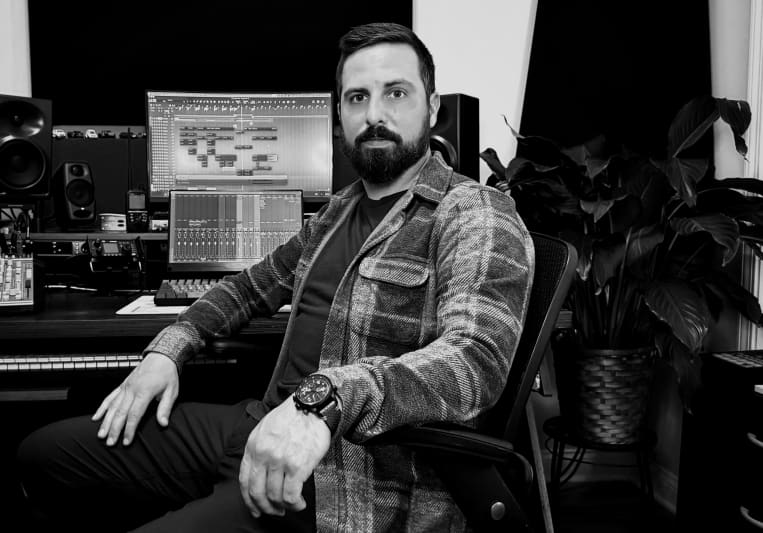
After years on the road engineering for King Buffalo and All Them Witches, I bring a musician's ear and a road-tested instinct to every mix. I make records that sound like the band — not like a mix.
I've mixed and engineered records in traditional studios as well as cabins, warehouses, living rooms, castles, and at least one cave. After running Last Wave Music Group in Nashville and spending years on the road with King Buffalo and All Them Witches, sharing stages with Clutch, Mastodon, Primus, and Uncle Acid. I settled into a focused remote mixing practice in Indianapolis.
My goal is simple: when you hear the playback, it should sound exactly like what you heard in your head when you wrote the song — only better. I don't impose a sound, I excavate the one that's already there.
Clients have called it alchemy. I just call it listening.
Send me a note through the contact button above.
Interview with Grant Husselman
Q: Tell us about a project you worked on you are especially proud of and why. What was your role?
A: Acheron by King Buffalo. I still can't quite believe we pulled that off. We dragged everything into a cave 15 stories underground at Howe Caverns outside of Syracuse, NY. Twelve hours to get in, set up, dial in sounds, track the whole record live, and get out. At one point I had to move my entire control room setup 200 yards deeper into the cave because of cable run issues. Total chaos in the most beautiful way. I've never been in a more alien and inhospitable space for recording in my life, and I've never had a tighter timeline. I also got to mix that one, which makes it the only King Buffalo record I both engineered and mixed start to finish. Seeing people out in the world call it their favorite King Buffalo record hits different. Proud dad moment for sure.
Q: What are you working on at the moment?
A: Too many projects! Right now I'm doing a full redux of my friend Blake's debut record as Aiwass, the same record that got us working together seven years ago. He played and recorded everything on it and it rips, but it was due for an update. I'm redoing all the drums on it too, which I haven't done on a record in a hot minute. Can't wait to put that one out. I also recently cracked open the archives from my old reggae label in Nashville, combed through all the unreleased material, and I'm putting together a 14 track dub album out of all of it. Second dub project in as many years. Maybe I'm back on the controls for real... On top of that I revived an old punk project from the Nashville days with my original guitarist and vocalist. We pulled up some demos from after a 2022 tour and immediately knew we had to make it into a full record. Early stages but we're writing and building it back up. And I'm sitting on a 10 track instrumental hip hop album I made during my final years touring with King Buffalo. All heaters. Just needs time to mix. Honestly all of it feels connected. I'm in a phase of going back through the most inspired periods of my life and breathing new life into that work. I've been falling back in love with music and the craft all over again, and it feels completely natural to let that lead.
Q: Is there anyone on SoundBetter you know and would recommend to your clients?
A: Honestly I'm fairly new to the SoundBetter world. My whole career has lived in the word of mouth realm so this is a new frontier for me. That said I have no doubt some of my Nashville network is on here, and if I find them I'll be sending people their way without hesitation.
Q: Analog or digital and why?
A: Digital, and I'll never look back. I don't miss broken tape machines, hunting down a fresh reel, or dragging an intern in for recalls. Give me the music with as few hurdles as possible. Digital can sound undeniably analog these days and the end listener will never know the difference. I'll hang my hat on that. When it comes to the creation of the music itself though, analog versus digital, tubes versus modeling, MIDI versus real keys, the answer is always whatever inspires the best performance. They're just tools. It all comes down to how you use them.
Q: What's your 'promise' to your clients?
A: I'm going to make you sound like you. Every time. I'll add depth, dimension, and sometimes something completely unexpected that you never saw coming. But what you get back from me is always going to be the best version of yourself that you've ever heard. That's the promise.
Q: What do you like most about your job?
A: Meeting new people, solving the puzzle of how to make their music shine, and getting turned onto bands I never would have found otherwise. But honestly my favorite moment of any project is that first mix session. Loading up all the files, hitting play, and just listening. Building that first monitor mix with nothing but faders and pans. No plugins, no processing, just the raw material. I try to think like an artist in that moment, not an engineer. Everything else flows from there.
Q: What questions do customers most commonly ask you? What's your answer?
A: Honestly? Rates and turnaround time. That's usually it. Which I think says something about the kind of relationships I build with clients. By the time someone is reaching out to me they've already done their homework and they trust what I'm going to do with their music. The housekeeping is just housekeeping. Beyond that I get asked about influences a lot, what I think of certain bands, what it was like touring with Primus or Mastodon. Rarely process stuff. I think people hire me for the feel, not the formula.
Q: What's the biggest misconception about what you do?
A: That AI is going to replace us. Not a chance. AI is only as good as what you feed it and what it has to draw from, and from everything I've seen it doesn't do emotion. It can approximate. There's a difference between a mixed media painter throwing huge gestural strokes onto a canvas while interpreting their own feelings about what they're seeing, and someone turning that painting into a spraypaint stencil. One is a human being processing the world. The other is a copy of a copy. Mixing records is the former. Always will be.
Q: What questions do you ask prospective clients?
A: Honestly I just like to talk. The first thing I want to know is what you're listening to right now, and what you were listening to when you were tracking the record. Influences tell me everything I need to know about where you're trying to go and what tools to reach for when we get there. Beyond that I just like getting to know people. The more I understand what makes you tick as a person, the better I understand what you're trying to say with your music. Those two things are never as separate as people think. I also always ask how they found me. I'm a pretty under the radar guy so the answer is usually interesting.
Q: What advice do you have for a customer looking to hire a provider like you?
A: If you're not looking to make a lifelong friend, you might be barking up the wrong tree. Every artist I've worked with I've developed a deep connection with, and even when we're not actively working together anymore we still talk, I still cheer them on, and I still give them all the advice they need and probably some they didn't ask for. It's never been a transaction for me. It's not going to start now.
Q: If you were on a desert island and could take just 5 pieces of gear, what would they be?
A: An MPC, a Sennheiser 421, a good pair of headphones, my OP-1, and an SP-303. Good news is I already have all of that in a Pelican case ready to go. Probably a surprising answer for a guy known for rock records, but I'm assuming I'm not tracking any bands on this island. Just me, some samples, and a lot of time to get weird.
Q: What was your career path? How long have you been doing this?
A: I was lucky enough to attend Belmont University, which got me elbow deep in Nashville studios as early as 2010. I graduated in 2013 and almost immediately opened my own studio just south of Broadway, back when that kind of thing was still affordable and possible. I've been at it pretty much ever since. When I was younger my approach was simple. I'm going to do this for a living or starve to death trying. Fortunately it didn't come to that.
Q: How would you describe your style?
A: One word? Classic. I lean on traditional mixing techniques that let tracks breathe and stand on their own in a space I carefully curate for the music to live in. I reach for saturation before EQ, and I have a deep love for reverb and delay, even when the end listener won't consciously notice either is there. Especially then, actually. Being a drummer by trade informs everything I do on the mix side, and drum sounds are probably my bread and butter. I obsess over getting them right in a way that only someone who has spent countless hours behind a kit can. With rock music it's pretty simple. If your drums don't hit, nothing else matters.
Q: Which artist would you like to work with and why?
A: Right now, Gojira. They're heavier than my usual world but they might be the tightest band on the planet at the moment. What gets me is that the technicality always serves the song. It pushes things forward instead of showing off. Joe's vocals and lyrical content are incredible, and honestly I'd just love to get my hands on Mario's drums and make them absolutely slam. Full disclosure though, it'd probably be some of the lightest mix work I'd ever do. Those guys don't need much help. Maybe that's exactly why I picked them.
Q: Can you share one music production tip?
A: Tune out the noise. We get bombarded constantly with "try this plugin, buy this channel strip, achieve this sound like never before." It's marketing, not craft. The year I stopped chasing the next big thing and committed to mastering the tools already in front of me was the year my mixes reached levels I didn't know I was capable of. Whatever you have right now is enough. Learn it deeply and it'll surprise you.
Q: What type of music do you usually work on?
A: Almost exclusively rock and rock adjacent for client work. That's my happy place and where my deepest roots are. Outside of client projects I stay busy with personal work in hip hop beats. Not the polished stuff. I'm hunched over an MPC chopping soul and funk samples, chasing that 90s boom bap sound I grew up obsessed with. Those production instincts cross-pollinate more than people might expect. I still dabble in some dub and reggae as well, which keeps my ears fresh and honestly informs everything I do on the rock side. The production sensibilities cross-pollinate more than people might expect.
Q: What's your strongest skill?
A: Getting the most out of a musician. That's always been it. Years of playing in bands and living in studios gave me a feel for musical energy that's hard to manufacture. I know what right feels like, and I know when we're not there yet. As an engineer, my job is to get the vibe in the room so dialed in that the artist forgets they're recording and just plays. As a mixer, it's to build enough trust that by the time we get there, the artist knows I understand their vision as well as they do. The best performances and the best mixes both come from the same place — trust. Everything I do is in service of that.
Q: What do you bring to a song?
A: Honestly? Whatever it needs. Sometimes that means I don't have to do much at all, just give the song three dimensions so the listener can exist in the world the artist already created. Other times it means a heavy hand: making parts wider and heavier, stripping back layers to let the element that carries the real message breathe. It's always case by case. But after all these years I've built a toolbox that can serve the music in any direction it needs to go. My job isn't to put my stamp on your record, it's to find the stamp that's already there and make it undeniable.
Q: What's your typical work process?
A: I work macro to micro. Before I touch a single plugin I set a full mix with just faders and pans — if the song doesn't work there, it won't work anywhere. From that I print a monitor mix and take it out into the world. AirPods, car speakers, wherever real people actually listen. I take notes on what the song needs and what it doesn't. Then I come back and work top down. 2-buss and instrument busses first before ever getting granular on individual channels. The goal is always cohesion before detail. This approach is rooted in how records were actually made in the 60s through the 90s. It feels more musical to me, less clinical. And it's a big part of why mixes that come out of here don't sound overproduced, because the process doesn't allow for it.
Q: Tell us about your studio setup.
A: My setup is streamlined by design. I spent my Nashville years chasing the gear dragon — working in world class studios and building my own room around analog desks like Soundcraft, DDA, and Neotek consoles with racks of outboard processing. Eventually I wanted all of that sonic character without the overhead. These days I run a Universal Audio based setup that lets me track and print through plugins the way I would their analog counterparts. I still couldn't leave the console world entirely behind though. I run an SSL SiX for summing at mixdown, which adds that unmistakable SSL color to everything that comes out of here. But honestly? The most important part of any setup is the room. I obsess over how this space sounds more than any piece of gear in it. If you can't hear what you're doing, none of the rest matters. It's not the gear, it's the ear.
Q: What other musicians or music production professionals inspire you?
A: My influences are all over the map, which I think makes me a better engineer. On the rock side, I consider myself a student of George Martin and the sonic world he built with the Beatles. So much of what we call "modern production" traces back to that work. From there, Glyn Johns and Eddie Kramer for their unmistakable sonic palettes, then forward to Butch Vig, Steve Albini, Danger Mouse, Vance Powell, and Dave Cobb. But honestly, modern production has its roots in reggae and hip hop, and I take that seriously. Scientist, Lee Scratch Perry, King Tubby, King Jammy. Those guys invented techniques we're all still using. And my hip hop Mount Rushmore: J Dilla, DJ Premier, RZA, and 9th Wonder. The throughline across all of them is that they left the craft better than they found it. At the end of the day I've always believed there are only two types of music — good and bad. I'll die on that hill. My taste is constantly evolving, but that core of people I've studied my whole life is always there to draw from.
Q: Describe the most common type of work you do for your clients.
A: These days I spend more time mixing than tracking. As much as I love tearing apart my studio and loading up the truck to capture lightning in a bottle somewhere unexpected, it takes the right project and the right space to pull me out of the mix cave. That focus has allowed me to develop a mixing approach that goes beyond process, one that's purely in service of the music. I come to every project with an open mind and no fixed agenda. Heavy hand when it calls for it, get out of the way when it doesn't. Whatever the track needs.
- Mixing EngineerAverage price - $350 per song
- ProducerAverage price - $500 per song
Standard mixing rate is for one song up to three revisions, each additional revision is $50. Turn around time is 1 week per mix (from start of mix to final), EP & LPs turnaround is usually 4 weeks.
- UA Apollo Twin
- UAD Satellite
- SSL SiX
- Focusrite Clarett 8 Pre
- UA Apollo x6
- Neumann KH120