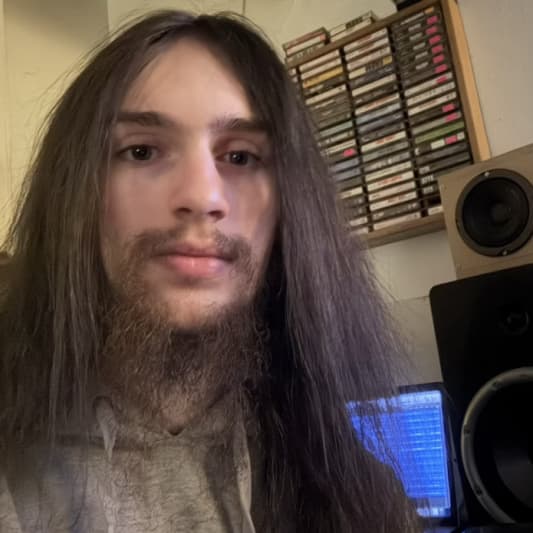
I am a mixing engineer that specializes in mixing hard rock, heavy metal, prog-rock, arena rock, pop-rock, and pop.
I’ve been recording and mixing for five years, working primarily on original music with my brother as well as covers of 80s and 90s songs. During that time, I’ve spent countless hours learning recording and mixing techniques and deeply researching how the engineers behind my favorite records achieved what I consider to be fantastic mixes. I then apply those techniques to my own mixes.
I’m offering my mixing services and would love to help you achieve the sound you’re looking for. Whether that’s something unique to you or your band, or classic sounds like a big and spacious 80s sound, a drier and more natural 70s sound, or a heavy and depth full 90s sound.
My goal is to help your music sound the way you imagine it.
I will mix your music to your vision using Logic Pro X and a variety of plugins and real hardware effects.
I will deliver a stereo wav file of the mix with no mastering so you can send it to a mastering engineer and I will deliver a stereo wav file of the mix with my mastering.
I do not do editing or tuning of tracks unless requested. All tracks should ideally be performed, edited and tuned as you desire before sending them to me.
I do not work on projects that contain generative AI created instrumental or vocal elements. My work is focused on music performed and produced by humans.
Contact me through the green button above and let's get to work.
Credits
Languages
- English
Endorse Nathan Veitenheimer2 Reviews
 check_circleVerified
Really good job ! Fast, meticulous, friendly, always answer to remarks and questions. I’ll work again with you soon Nathan !
He's a very good mixer and actually listens to the artist to get the best results ever with quick and fast responses I got my initial mix within a few hours of sending the multitracks, highly recommend
Interview with Nathan Veitenheimer
Q: What are you working on at the moment?
A: I’m currently working with my brother on our first EP it’s hard rock/metal with an 80s sound.
Q: What questions do you ask prospective clients?
A: Tell me a bit about the song and what kind of sound you have in mind for it. I’ll ask for a rough mix of your song or songs if it’s an EP or LP as well as how many tracks there are in the songs.
Q: What's your 'promise' to your clients?
A: I will deliver a mix you can be satisfied with. I’m very passionate about music and mixing and I always try to make my work the best it can be.
Q: Analog or digital and why?
A: Both. Digital is great for the recall, recording and mixing without unwanted saturation or degradation and ease of use. Analog can have a beautiful sound. The sound of real circuitry with its non linearities can sound massive and a well recorded tape just has a glue and air at the same time as well as added height and depth that I haven’t found anything else really does in the same way.
Q: If you were on a desert island and could take just 5 pieces of gear, what would they be?
A: Laptop with Logic Pro, an audio interface, studio monitors, an electric guitar and a Rockman headphone amp.
Q: Tell us about a project you worked on you are especially proud of and why. What was your role?
A: I’m proud of anything I do well because I’m always learning and improving, but I’m particularly proud of the cover my brother and I did of Def Leppard’s Comin’ Under Fire. We entered it in a cover contest Def Leppard held for songs from their album Pyromania. Although we didn’t win we had a lot of fun making it and it was the first Def Leppard song we had ever covered, so all things considered I’m pretty happy with how it turned out. I recorded, mixed and mastered the track. I used a Tom Scholz Rockman for the guitars because I wanted to lean more toward a Hysteria guitar sound. I also programmed the drums and created the drum sounds, while my brother did the vocals, bass guitar, additional drum programming and assistant engineering. I just love the huge 80s Def Leppard sound.
Q: What's the biggest misconception about what you do?
A: That mixing can save poorly recorded tracks. It can do a lot but I’ve learned from experience the better the recording quality and the closer you get the sounds to what you want on the way in the better the mix will be.
Q: What advice do you have for a customer looking to hire a provider like you?
A: Thoroughly explain how you would like your music to sound.
Q: Can you share one music production tip?
A: For huge vocal stack's record 10 to 20 or more vocals per side. 20 in the left channel and 20 in the right channel for example.
Q: What's your typical work process?
A: I typically start a mix by setting up the session the way I like it. If there’s a rough mix I’ll listen to that first to get a sense of the panning and the overall direction you’re going for. From there I’ll mix the song using volume, panning, eq, compression, gating, saturation, automation and effects such as reverbs, delays, chorus, flangers and phaser’s until it’s sounding solid. Then I’ll send it to you with a rough master applied so you can hear it at a mastered loudness and more accurately compare it to released songs. I’ll ask for your feedback and any notes you may have, I’ll make any requested changes and work toward delivering a final mix you’ll love.
Q: What do you bring to a song?
A: My ideas of how it could sound based on what the artists vision and preference is. Along with technical skills to make that vision a reality.
Q: Is there anyone on SoundBetter you know and would recommend to your clients?
A: Ron Nevison, Daniel Duskin, Maria Triana
Q: What do you like most about your job?
A: The satisfaction of working on music whether it’s my own or others and taking raw multitracks and making them into an enjoyable mixed song.
Q: How would you describe your style?
A: I would describe it as aggressive, dynamic and spacious.
Q: What type of music do you usually work on?
A: Hard rock, arena rock, heavy metal, pop-rock, prog-rock, pop
Q: What's your strongest skill?
A: My knowledge of how to get certain sounds and being able to mix in different styles.
Q: Tell us about your studio setup.
A: I use Logic Pro X with a variety of plugins from brainworx and others and I use hardware effects such as Roland Sde-1000, Roland srv-2000, Boss CE-300 super chorus, Lexicon Lxp-15 II and Digitech 2120. My monitoring is a Presonus audio interface with M-audio BX8 studiophile monitors, Auratone 5c sound cubes and AKG headphones. I also have many guitar amps and bass amps and guitars and basses. As well as a big Tama drum kit.
Q: What other musicians or music production professionals inspire you?
A: Martin Birch, Mutt Lange, Mike Shipley, Nigel Green, Bob Clear Mountain, Terry Brown, Peter Henderson, Peter Collins, Peter McIan, Kevin Elson, Mike Stone, Dave Jerden, George Marino, Bob Ludwig, Ted Jensen just to name a few. There are so many great musicians and engineers to be inspired by.
Q: Describe the most common type of work you do for your clients.
A: Mixing.
I was the Recording, mixing and mastering engineer, guitarist and drum programmer in this production
- play_arrowScrow - Comin’ Under Fire (Def Leppard cover)
- Mixing EngineerAverage price - $150 per song
- Bass ElectricAverage price - $70 per song
- Electric GuitarAverage price - $70 per song
- Live drum trackAverage price - $100 per song
- Programmed drumAverage price - $70 per song
3-5 days for mixing per song, 5 revisions included.
Please send a rough mix.
3-5 days or longer per song and per service for Bass guitar, Electric guitar, Live drums, Programmed drums. 5 revisions.
- Def Leppard
- Iron Maiden
- The Cars
- Roland
- Boss
- Lexicon
- DigiTech
- M-audio BX8 Studiophile
- Auratone 5c
- AKG headphones
- Tech 21 NYC
- SR&D Rockman
- Gallien Krueger
- Peavey
- Marshall

10% off on mixing for EPs and LPs